Greater Vancouver's H2 2026 Market: Why Softness Persists Despite Inventory Gains
GVR's latest forecast reveals softer-than-expected sales in H1 2026, with economic uncertainty and trade tensions continuing to weigh on the market.
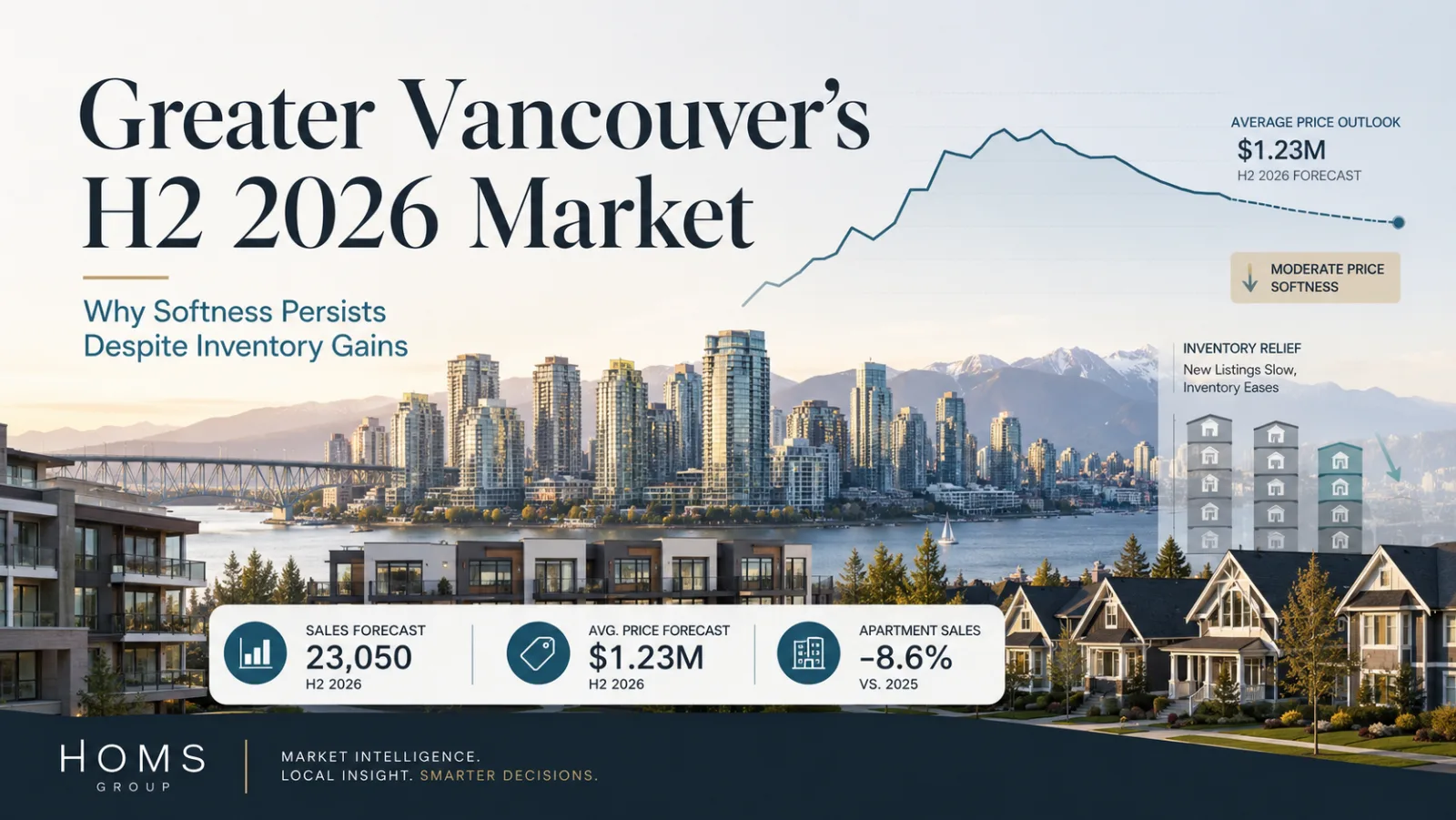
Greater Vancouver’s housing market is entering the second half of 2026 in an unusual position: prices have softened, inventory remains elevated, and buyers have more choice—but sales activity is still struggling to regain momentum.
Greater Vancouver REALTORS® (GVR) has released its updated H2 2026 Residential Market Forecast, revising both its sales and price expectations after a spring and summer that came in somewhat weaker than anticipated.
The forecast does not point to a market collapse. Instead, it describes something more nuanced: a slow, cautious market searching for equilibrium while buyers remain hesitant and sellers adjust to changing conditions.
Sales Are Running Behind Expectations
One of the clearest signals in the report is the continued weakness in transaction activity.
Through July, 2026 sales were:
- 6.2% below GVR’s year-to-date forecast
- 18.6% below the 10-year seasonal average for July
While 2026 is not the weakest year on record, GVR notes that year-to-date sales are among the lowest observed historically and are running slightly behind 2025.
GVR originally expected 24,900 transactions in 2026, representing a 4.6% increase over 2025.
Its revised H2 forecast now calls for approximately:
23,050 residential sales in 2026 — a 3.2% decline from 2025.
That revision suggests the market recovery anticipated earlier in the year has been delayed rather than accelerated.
Not All Property Types Are Moving Together
Looking only at the regional sales total hides an important part of the story.
GVR’s revised forecast shows very different expectations depending on property type:
| Property Type | 2025 Sales | 2026 Forecast | Change |
|---|---|---|---|
| Apartment | 12,038 | 11,000 | -8.6% |
| Attached | 4,890 | 5,000 | +2.2% |
| Detached | 6,725 | 6,800 | +1.1% |
| Market Total | 23,800 | 23,050 | -3.2% |
The biggest weakness is clearly in the apartment market, where GVR expects transactions to fall approximately 8.6% from 2025.
Detached and attached properties, meanwhile, are forecast to finish slightly ahead of last year.
That distinction matters for homeowners and investors because there is no single “Greater Vancouver market.” A condominium seller in one neighbourhood may be facing very different supply and demand conditions from a detached homeowner only a few kilometres away.
What’s Holding Buyers Back?
The most interesting question raised by the forecast is also the hardest to answer:
Why aren’t lower prices and greater selection generating stronger sales?
GVR says there is no single empirical explanation, but identifies several likely contributors.
Consumer Confidence Remains Weak
Bank of Canada consumer survey data referenced by GVR suggests that British Columbia buyers appear more hesitant to participate in the housing market than buyers elsewhere in Canada.
At the same time, BC sellers appear comparatively more eager to list their properties.
That combination—hesitant buyers and more willing sellers—helps explain why inventory has remained elevated and why buyers have gained negotiating leverage.
Immigration Growth Has Slowed
GVR also identifies the significant slowdown in the pace of immigration as a probable contributor to weaker housing activity.
Population growth has historically been an important source of housing demand across Greater Vancouver. A slower inflow of new residents can therefore reduce some of the incremental demand that previously supported both rental and ownership markets.
Investors Are Less Active
Another factor identified by GVR is a relative lack of investors willing to participate in the current market.
That could have an outsized impact on the apartment segment, where investor participation has traditionally represented an important component of demand.
The forecast’s 8.6% expected decline in apartment sales is therefore particularly noteworthy.
Trade and Economic Uncertainty Remain a Drag
Ongoing trade tensions between Canada and the United States continue to create uncertainty around employment, economic growth and consumer confidence.
For households considering a major financial commitment such as purchasing a home, uncertainty itself can be enough to delay a decision—even when prices become more attractive.
Interest Rates May Not Provide an Immediate Catalyst
Normally, weaker housing activity raises expectations that lower borrowing costs could bring buyers back into the market.
GVR’s base case suggests that this catalyst may not arrive before year-end.
According to the forecast, the Bank of Canada has maintained its policy rate at 2.25% since October 2025.
Although inflation concerns have increased the possibility of rates moving modestly higher in 2027, GVR considers the probability of a Bank of Canada rate increase before the end of 2026 relatively low.
The important implication for housing is that borrowing costs may not change enough in the short term to materially alter buyer behaviour.
Without a major interest-rate catalyst, the market may need to rebalance primarily through prices, inventory and time.
Inventory Is Elevated—but the Direction Is Changing
This may be one of the most important developments for the second half of 2026.
Elevated inventory has been one of the defining characteristics of the current Greater Vancouver market. More listings combined with weaker buyer participation have contributed to downward pressure on prices.
But GVR is now seeing signs that the supply picture may be changing.
The report notes that standing inventory has begun to slowly recede from recent highs, largely because the pace of newly listed properties entering the market is slowing.
If that trend continues while sales remain steady, the balance between supply and demand could gradually tighten.
That does not necessarily imply another rapid price cycle. Instead, GVR expects declining inventory to provide modest support for prices through the remainder of 2026.
This creates an important distinction:
The market still offers buyers relatively strong selection, but the inventory advantage may not continue expanding indefinitely.
Prices: Soft, but Far From a Collapse
GVR has also slightly reduced its year-end price expectations.
Its forecast for average residential prices is:
| Property Type | 2025 Actual | 2026 Forecast | Change |
|---|---|---|---|
| Apartment | $755,000 | $750,000 | -0.7% |
| Attached | $1,230,000 | $1,215,000 | -1.2% |
| Detached | $2,059,000 | $2,030,000 | -1.4% |
| Market Total | $1,228,000 | $1,230,000 | +0.2% |
The broader market average is therefore forecast to remain almost unchanged, at approximately $1.23 million, even though individual property categories are expected to experience modest price declines.
That distinction is important.
A regional average can be influenced by the mix of homes being sold. It does not necessarily mean that the value of a typical property is increasing.
For buyers and sellers, property-type and neighbourhood-level data can therefore be considerably more useful than a single Greater Vancouver average.
A Market With More Buyer Leverage
The combination of slower sales and elevated inventory has shifted negotiating conditions compared with the highly competitive markets Greater Vancouver experienced in previous years.
For qualified buyers, that can mean:
- More properties to compare
- More time for due diligence
- Greater ability to negotiate price
- More opportunities to include conditions
- Less pressure to make immediate decisions
- Potential opportunities among listings that have accumulated days on market
But buyers should avoid assuming that every property will continue declining in value.
If inventory continues to recede, some of today’s negotiating advantage could gradually diminish.
The better question is not simply:
“Will Vancouver prices go down?”
It is:
“Is this particular property fairly priced relative to the alternatives available today?”
What This Means for Sellers
For sellers, the current market increasingly rewards accurate pricing rather than aspirational pricing.
In an environment where buyers have more options, a property that enters the market noticeably above competing listings may quickly accumulate days on market.
That can eventually result in price reductions and weaker negotiating leverage.
Sellers should therefore pay close attention to:
- Recent comparable sales
- Competing active listings
- Inventory within the immediate neighbourhood
- Days on market
- Price reductions among competing properties
- Property condition and presentation
- Demand for the specific property type
- The sales-to-active-listings environment in the local area
The objective is no longer simply to “list high and negotiate.”
It is to position the property where today’s buyers perceive value.
What This Means for Investors
Investors should pay particular attention to the apartment segment.
GVR’s forecast of an 8.6% decline in apartment transactions suggests materially weaker activity than in the attached and detached segments.
That does not automatically make apartments unattractive investments.
It does mean that acquisition decisions should increasingly be evaluated property by property, considering factors such as:
- Purchase price relative to comparable units
- Rental income potential
- Monthly strata fees
- Upcoming capital expenditures
- Depreciation reports
- Special-levy exposure
- Insurance costs
- Vacancy assumptions
- Financing costs
- New housing supply in the surrounding area
- Long-term neighbourhood fundamentals
In a slower market, disciplined underwriting becomes more important than relying primarily on broad market appreciation.
What Could Change the Forecast?
The GVR forecast also identifies meaningful risks in both directions.
Downside Risks
A recession accompanied by rising unemployment could weaken housing demand more significantly than currently anticipated.
Additional tariffs on Canadian exports to the United States could also create an economic shock, particularly if they affect employment and consumer confidence.
A more significant employment downturn could affect not only transaction volumes but also property valuations by reducing the pool of financially qualified buyers.
Upside Risks
The clearest upside catalyst would be lower borrowing costs.
If economic weakness resulted in interest-rate reductions, affordability could improve and some sidelined buyers could return to the market faster than expected.
The second upside scenario involves inventory.
If listings decline faster than anticipated while sales remain relatively stable, supply-demand conditions could tighten enough to produce modest price appreciation before year-end.
GVR nevertheless considers significant price appreciation beyond its earlier H1 forecast unlikely under current conditions.
The Bigger Picture: Greater Vancouver Is Rebalancing
The H2 2026 forecast is best understood not as a prediction of a crash or a rebound, but as a rebalancing market.
Buyers remain cautious.
Sellers are adjusting expectations.
Inventory remains elevated but has begun to decline.
Prices are experiencing modest pressure rather than severe deterioration.
And without a major shift in borrowing costs, the market may continue moving slowly through the remainder of the year.
For homeowners, buyers and investors, that means broad regional headlines are becoming less useful.
The opportunity—and the risk—is increasingly local.
Two properties within the same municipality can perform very differently depending on property type, neighbourhood inventory, condition, pricing, competition and buyer demand.
What This Means for Your Strategy
The H2 2026 market demands precision.
For sellers, success will increasingly depend on understanding exactly how a property compares with competing inventory and recent sales.
For buyers, today’s softer conditions can create opportunities—but value still needs to be assessed at the property level rather than assumed from regional trends.
For investors, property type, financing, rental economics and local supply should matter more than expectations of broad market appreciation.
In other words, 2026 is becoming a market where property-level intelligence matters more than market-wide averages.
Make the Market Data Specific to Your Property
Regional forecasts provide valuable context, but they cannot tell you exactly where your property sits within today’s market.
HOMS Property Score helps translate broader market conditions into property-level intelligence by examining the factors that matter for an individual home and its surrounding market.
Access HOMS Property Score today to benchmark your property against current market conditions, or book a consultation with our team to discuss your selling, buying or investment strategy.
Source: Greater Vancouver REALTORS® — 2026 H2 Residential Market Forecast. Forecast figures represent GVR Economics estimates and are subject to change as economic and market conditions evolve.
HOMS Real Estate Services Corp. is a technology, intelligence and multidisciplinary services company and is not a licensed real estate brokerage.Licensed real estate trading services are provided by Moji Dargahi, licensed real estate professional with Royal Pacific Realty Corp.HOMS is not an engineering firm: analysis outputs are preliminary screening estimates for informational purposes and are not sealed engineering documents. Tool outputs are estimates for informational purposes only and do not constitute an appraisal, recommendation, financial advice or legal advice. Fit results compare listing data with numbers you enter; they are not a pre-approval.